TECH 2026 in Heilbronn - A festival celebrates Germany and Europe in a new edition
NSTR.security will demonstrate at TECH 2026 why true disruption starts with self-disruption: challenging your own core model, moving away from traditional fixed installations, and championing security Made in Germany.

Carsten Simons
News
May 5, 2026
4 min read

The TECH 2026 in Heilbronn is not a classic event, but a curated gathering at the European executive level. Behind the platform are the Handelsblatt Media Group and Schwarz Digits, representing the exact combination of economic opinion leadership and technological implementation. The line-up is correspondingly impressive: leaders such as Timotheus Höttges (Deutsche Telekom), Gernot Döllner (Audi), Hauke Stars (Volkswagen), Michael Schoellhorn (Airbus) or Maja Göpel meet decision-makers from defense, infrastructure, and tech. The focus is clearly on the big topics: AI, cybersecurity, defense, and critical infrastructure – and the question of how Europe can become more sovereign, faster, and more independent in these areas.
Carsten Simons will speak on June 1, 2026, from 11:15 AM to 11:30 AM on the Defense Stage in the session “Interview: Is the Security Train Already Gone for Germany? The Only Way Back Is Disruption - We’ll Show How”. The conversation will be moderated by Moritz Schönleber.
The title is fitting because it doesn't stop at a general feeling of security. It addresses the question of whether Germany is still fast enough regarding physical security, critical infrastructure, and technological sovereignty.
The TECH clearly describes the problem: Germany does not have an innovation problem in security, but rather a model problem. For too long, low costs, long-term projects, and supplier dependencies have been accepted as the standard. The answer, they say, is to change the economics, remove friction, and to make it possible to produce, deliver, and operate security technology in Germany at scale.
This is exactly where NSTR.security comes in.
Disruption begins with ourselves.
Why NSTR.security is showing how Germany can rethink physical security at TECH 2026
Many companies talk about disruption. Usually, they mean: changing the market, attacking competitors, using new technologies.
At NSTR.security, disruption starts earlier.
It begins with the willingness to challenge one's own model of success.
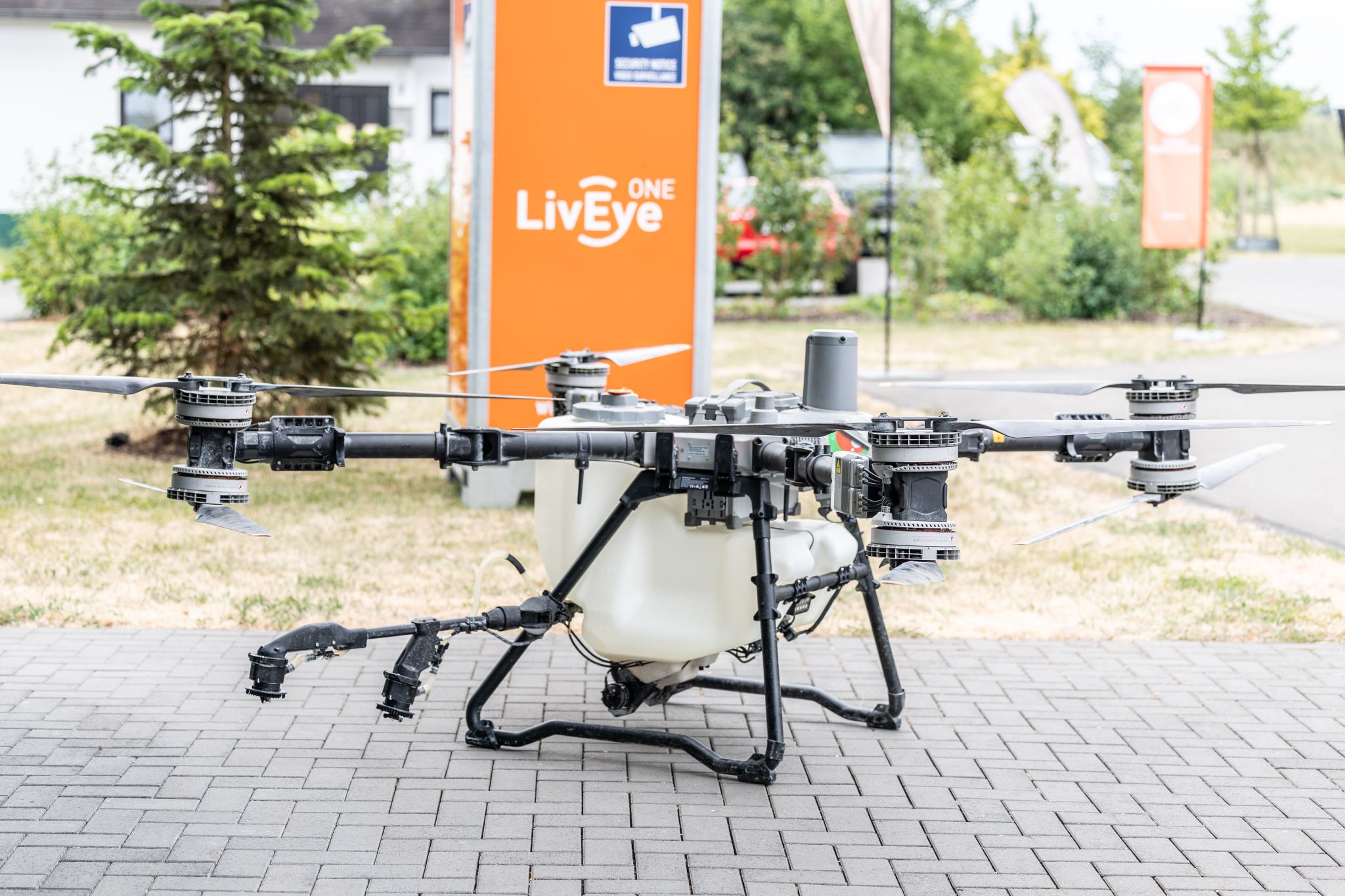
LivEye grew large with mobile video surveillance: flexible systems, rapid deployability, 24/7 control center, Security-as-a-Service. This model changed a market because it enabled customers to protect themselves without making their own investments, without operational complexity, and without long project lead times. LivEye describes this approach itself as an all-round service package consisting of planning, installation, monitoring, and response. (LivEye)
With NSTR.security, LivEye is now taking the next step - deliberately going against parts of its own core business.
Because anyone who truly wants to rethink security cannot just make existing products better. They must be prepared to cannibalize their own model if this results in greater customer benefit.
That is exactly what NSTR is.
1. Disruptive towards its own core business
The classic mobile video tower was and remains a powerful product. It delivers height, field of vision, self-sufficiency, and rapid deployability wherever temporary or project-based protection is needed.
But not every site needs a tower.
At many properties, there are already walls, facades, poles, streetlights, hall structures, or other mounting points. This is exactly where NSTR comes in. The idea: why set up a large mobile system when a compact, permanently mountable security module can achieve the same operational effect?
Carsten Simons put this point very clearly in an interview: NSTR makes its own tower somewhat redundant and at the same time competes with the classic permanent installation industry. This is self-disruption - not as a buzzword, but as a strategic decision. (git-sicherheit.de)
This is the real courage behind NSTR.security: LivEye does not protect the old model. LivEye protects the customer benefit.
If a smaller, smarter system that can be planned faster is the better answer for many use cases, then that is precisely the system that must be built — even if it challenges the existing core product.
2. Disruptive towards classic permanent installation
However, the greatest effect lies in comparison to classic permanent installation.
Permanently installed video surveillance in many companies is still a project business: inspection, planning, offering, cabling, network, server, data protection clearance, installer, IT coordination, maintenance contracts, subsequent adjustments. This makes many of these projects slow, expensive, and difficult to calculate.
NSTR.security attacks this exact logic.
Instead of thinking of security as a complicated installer project, NSTR turns it into a predictable, standardized, and scalable security model. Customers can use an online planning tool to prepare their surveillance concept on a map and get an initial idea of what the solution can look like and what it will cost. (NSTR)
This shifts control.
Security does not only become understandable after a specialist has been on-site. It becomes visible earlier, planable earlier, and decidable earlier. This is precisely where the break with the classic permanent installation industry lies.
NSTR does not reduce complexity by omitting performance. NSTR reduces complexity by integrating key components: cameras, AI analysis, data processing, transmission, speakers, light signals, connection to the control center, and operation. In the GIT interview, Carsten Simons describes NSTR as an integrated compact system that re-evaluates classic project planning costs. (git-sicherheit.de)
The result is not just another CCTV product. It is an alternative to the old way of thinking about CCTV projects.
3. Disruptive through Made in Germany
“Made in Germany” is not a decorative addition for NSTR.
It is part of the disruption.
Because modern video surveillance is no longer just hardware. It is a security-critical system comprising camera, AI, edge computing, data transmission, software, control center, updates, data protection, operation, and response. Anyone who does not understand, control, and advance this system carries a structural risk in security-sensitive environments.
NSTR.security therefore pursues a consistent onshoring approach. On Carsten Simons' LivEye profile, NSTR is described as an independently operating product or venture that relies 100 percent on Made in Germany, onshoring, data access, compliance, supply chain, and edge expertise. (LivEye)
This is disruptive because it turns the typical logic of many security markets on its head.
Instead of buying as cheaply as possible, integrating somewhere, and then selling it as a system, it is about: reclaiming key competencies, reducing dependencies, securing lifecycle control, and turning that into an operational advantage.
The TECH page sums up this strategy similarly: With NSTR.security, Carsten Simons is pursuing a counter-movement against dependencies, aiming to regain lifecycle control and turn Made in Germany from a label into an operational advantage for corporate security and critical infrastructure. (Handelsblatt)
That is the point: Made in Germany is not nostalgia here. It is security architecture.
4. Disruptive by design
NSTR is also different because the product does not look like classic security technology.
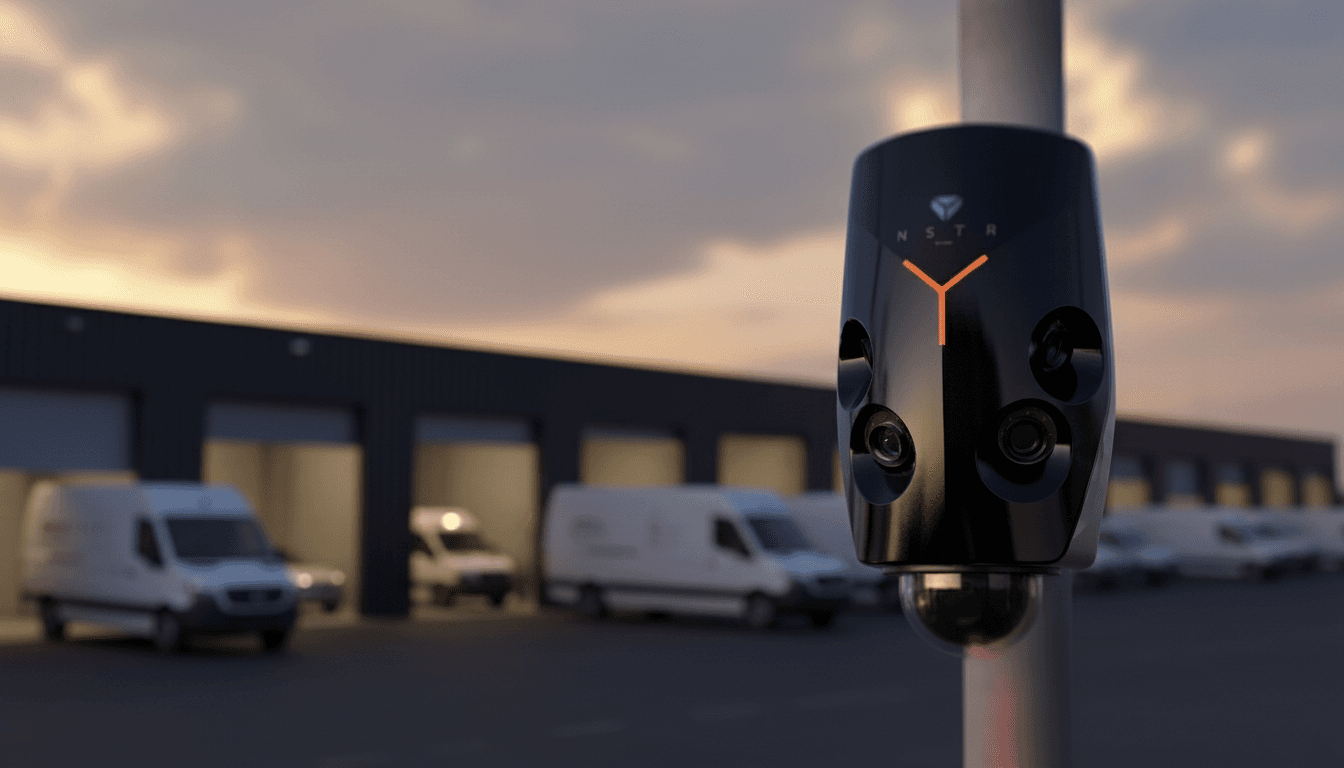
Many CCTV products are functional, technical, visibly retrofitted - but rarely a consciously designed part of the environment. NSTR starts right here: compact, recognizable, high-quality, mountable on a wall or pole, and designed as an independent security module.
In the GIT interview, Carsten Simons describes the aspiration to reduce the system to a “shoebox size” — without compromising on performance — while also setting standards in design. Classic CCTV products are often functional, but visually, they are not a great calling card. (git-sicherheit.de)
The design is therefore not superficial. It is part of the business model.
A compact module can be planned differently, mounted differently, sold differently, scaled differently, and perceived differently than a classic CCTV project or a mobile tower. It lowers the barrier to entry, increases acceptance, and makes professional security possible in places where large systems would be oversized or classic permanent installations too sluggish.
On the product side, NSTR is also designed for this new category: The NSTR version operates with five integrated cameras, a surveillance radius of around 200 degrees, covering an area of around 4,300 square meters; additionally, AI-supported analysis, 24/7 control center connection, direct audio response to intruders, and escalation are integrated into one system. (BDSW)
This creates a new product image: not a tower, not a physical camera alone, not purely software — but an integrated security module.
NSTR is not an update. NSTR is an alternative model.
NSTR is not simply the next camera.
NSTR is an alternative model to four old assumptions:
First: that a successful company must protect its core product.
NSTR shows: A company must protect customer benefit - even against itself.
Second: that permanent installation must inevitably be slow, complex, and individually planned.
NSTR shows: Professional video surveillance can be more standardized, faster, and more transparent.
Third: that Made in Germany is only a promise of origin.
NSTR shows: Origin can become a control, compliance, and operating strategy.
Fourth: that security technology only needs to function.
NSTR shows: Design also helps determine whether a system scales, is accepted, and is actually deployed.
This is the disruptive core.
Not a better product within old categories. But a product that challenges multiple categories simultaneously.
The greatest lever: Rethinking permanent installation
The market for classic permanent installation is large but inertia-ridden. This is exactly why the leverage here is greatest.
Many companies have real security vulnerabilities but shy away from tackling classic CCTV projects. Too much effort. Too little transparency. Too many interfaces. Too high upfront investments. Too long to implement.
NSTR.security addresses this friction loss.
A power connection is sufficient; additional WLAN or network infrastructures are not required, according to the BDSW press release. The solution is planned, configured, and managed as a subscription model; events are documented and processed in the 24/7 control center. (BDSW)
With this, NSTR shifts the benchmark.
No longer: How do we construct a classic permanent installation project as neatly as possible?
Rather: How do we replace as much project complexity as possible with a mass-production ready, operable, and accountable system?
This question is disruptive.
Because it does not optimize within the old value chain. It builds a new one.
Conclusion: Disruption means allowing the better model to prevail
NSTR.security is disruptive because it does not just challenge competitors.
It challenges LivEye itself.
It challenges the permanent installation industry.
It challenges global dependencies.
It challenges the old design image of security technology.
And that is precisely why NSTR fits into the House of Defense at TECH 2026.
Because defense and security in the future will not just be decided by more technology, but by better models: faster to plan, more sovereign to control, more economically scalable, and with clear operational accountability.
Germany does not need another debate on whether security is becoming more important.
Germany needs security solutions that become effective faster.
NSTR.security shows how that can be achieved.
Visit NSTR.security in the House of Defense at TECH 2026 in Heilbronn.